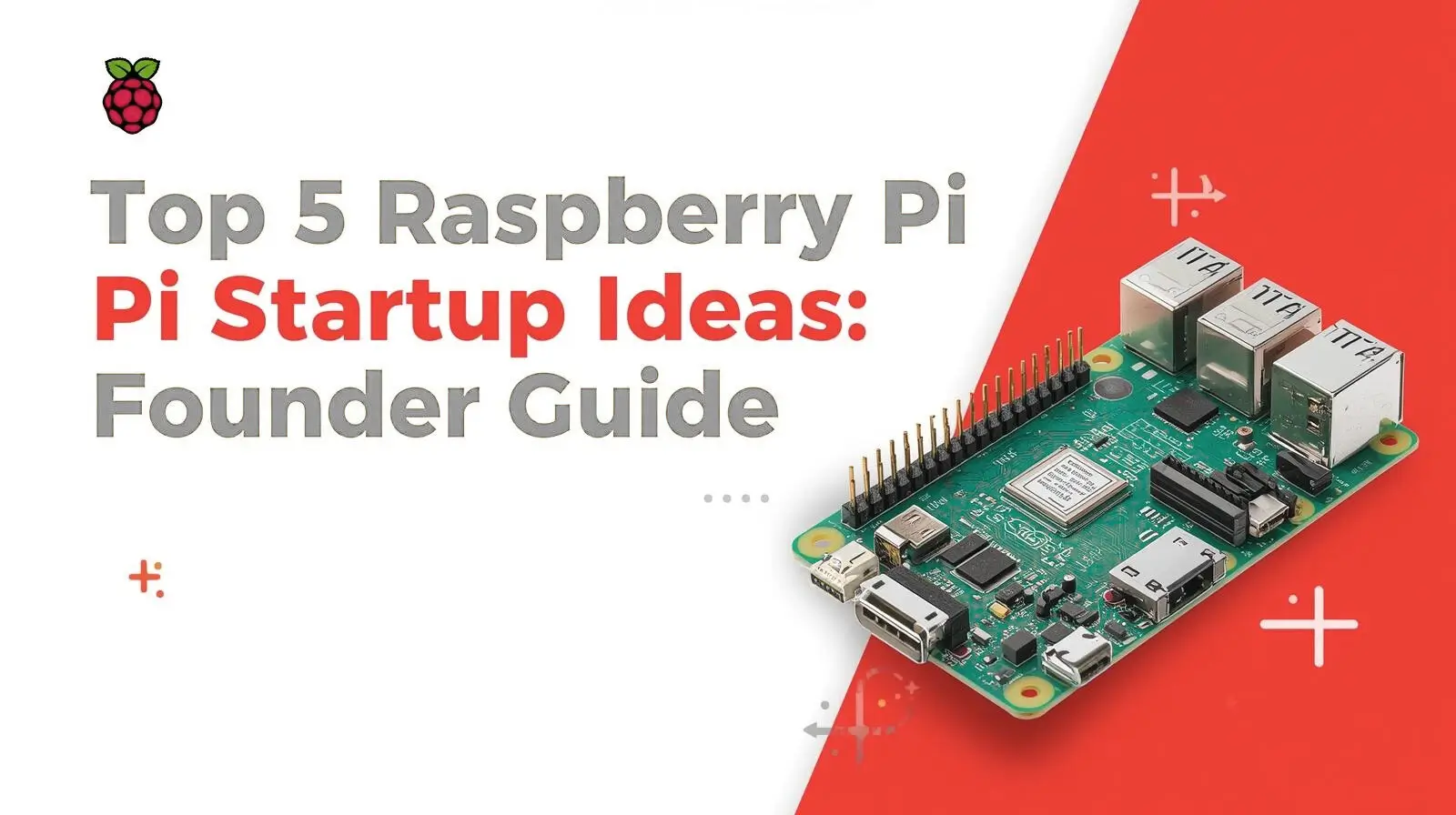
As a founder eyeing the intersection of hardware innovation and scalable software, the Raspberry Pi stands out as a powerhouse for bootstrapping startups. This credit-card-sized computer (now in its fifth generation with enhanced AI capabilities) costs under $100 and supports everything from IoT prototypes to edge computing deployments. In 2025, with global IoT spending projected to hit $1.1 trillion, Raspberry Pi-based ventures offer low-barrier entry into high-growth markets like smart homes, education, and health tech. Whether you're a solo maker or building a team, these ideas leverage the Pi's GPIO pins, camera modules, and Python ecosystem for rapid MVPs. Below, we dive into five startup ideas, complete with market insights, competitors, YouTube tutorials for proof-of-concept, and founder tips to get you from prototype to pitch deck. For more hands-on inspiration, check out our Top 10 IoT Projects You Can Build with Raspberry Pi in 2025 and equip yourself with the 10 Must-Have Accessories for Your Raspberry Pi IoT Projects.
1. AI-Enhanced Smart Home Automation Hub
Idea Overview
Build a privacy-focused, open-source smart home hub that integrates lights, thermostats, and sensors via Raspberry Pi. Use the Pi's built-in AI accelerator for local voice processing and automation rules, avoiding cloud dependency. Sell as a DIY kit or subscription service with custom firmware updates. Dive deeper with a similar project in our top IoT projects guide.
Market Size
The global smart home automation market is valued at $132.65 billion in 2025, growing at a CAGR of 27.11% through 2034, driven by demand for energy-efficient and secure connected devices.
Key Competitors
- Amazon (Alexa & Echo): Dominates with voice control but raises privacy concerns due to cloud reliance.
- Google Nest: Strong in AI integration but ecosystem-locked.
- Apple HomeKit: Premium security focus, limited to iOS users.
- Samsung SmartThings: Versatile hub, but hardware-heavy.
Demo Video
Founder Tips
Start with Home Assistant OS for quick prototyping (it's free and Pi-optimized). Validate via Kickstarter for pre-orders, targeting eco-conscious millennials. Challenge: Zigbee/Z-Wave compatibility; partner with Seeed Studio for modules. Potential revenue: $99 kits + $5/month app subscriptions. Essential accessories include a Zigbee dongle and protective case (see our accessories roundup).
2. Modular Educational Robotics Kit
Idea Overview
Create affordable, Pi-powered robotics kits for K-12 STEM education, with modular components for building robots that teach coding, physics, and AI. Include drag-and-drop software and lesson plans, positioning it as a "LEGO for robotics" with Raspberry Pi as the brain.
Market Size
The educational robotics market is worth $1.8 billion in 2025, expanding at a 17.2% CAGR to $3.98 billion by 2030, fueled by global STEM curricula mandates.
Key Competitors
- LEGO Education: Curriculum-aligned kits, but pricey and less AI-focused.
- Wonder Workshop (Dash & Dot): Kid-friendly coding robots, strong in elementary schools.
- Sphero: Gamified orbs for programming, but limited modularity.
- VEX Robotics: Competition-oriented, targets high school.
Demo Video
Founder Tips
Pilot with local schools via grants from Raspberry Pi Foundation. Use Scratch for kid-proof coding. Challenge: Durability for classroom abuse; source rugged cases from AliExpress. Revenue model: $79 kits sold B2B to districts, plus teacher certification courses. Stock up on jumper wires and breadboards from our must-have accessories list.
3. Edge AI Security Camera System
Idea Overview
Develop a plug-and-play AI camera using Raspberry Pi's AI Kit for real-time object detection, facial recognition, and alerts. Target small businesses and homes with solar-powered, weatherproof enclosures and app-based monitoring. Explore a full tutorial in our security camera project.
Market Size
The AI camera market stands at $12.42 billion in 2025, with a 22.81% CAGR to $78.72 billion by 2034, propelled by rising surveillance needs in retail and smart cities.
Key Competitors
- Spot AI: Unified video analytics platform, excels in enterprise search.
- BriefCam: Video summarization for quick insights, but software-heavy.
- Avigilon (Motorola Solutions): High-def hardware with ML alerts.
- Rhombus Systems: Cloud-flexible, but subscription-locked.
Demo Video
Founder Tips
Leverage Frigate NVR software for open-source AI. Bootstrap with Indiegogo, emphasizing no-subscription privacy. Challenge: Battery life; integrate low-power modes. Monetize via $149 hardware + optional $2/month cloud backup. Don't forget the Pi Camera Module and cooling fans (detailed in our accessories guide).
4. Portable Telehealth Monitoring Kit
Idea Overview
Design a Raspberry Pi-based wearable kit for remote vital tracking (heart rate, SpO2, ECG) with Bluetooth sensors and telemedicine app integration. Focus on underserved rural markets or elderly care, with data encryption for HIPAA compliance.
Market Size
Portable medical devices market hits $77.14 billion in 2025, growing at 11.32% CAGR to $202.52 billion by 2034, amid home healthcare boom.
Key Competitors
- Medtronic: Enterprise-grade monitors, but bulky.
- Omron: Affordable BP cuffs, limited integration.
- Fitbit (Google): Consumer wearables, privacy issues.
- DexCom: Glucose specialists, niche focus.
Demo Video
Founder Tips
Certify with FDA Class II for credibility. Partner with telehealth apps like Teladoc. Challenge: Sensor accuracy; calibrate with MAX30102 modules. Revenue: $199 kits via Amazon, B2B to clinics. Integrate essential sensors like those recommended in our accessories blog for robust prototyping.
5. IoT Environmental Monitoring Station
Idea Overview
Launch a deployable Pi station for air quality, soil moisture, and noise tracking, with LoRaWAN for remote farms or urban sensors. Offer data dashboards for sustainability reporting, targeting agrotech and green cities. Build on ideas from our environmental monitoring project.
Market Size
Environmental monitoring market is $25.13 billion in 2025, with a 7.2% CAGR to $43.83 billion by 2033, driven by pollution regulations.
Key Competitors
- Danaher: Lab-grade sensors, enterprise scale.
- Honeywell: Industrial IoT focus, high cost.
- Thermo Fisher: Analytical precision, less portable.
- Siemens: Building-integrated, B2B heavy.
Demo Video
Founder Tips
Use MQTT for cloud syncing with AWS IoT. Seek EU Horizon grants for green tech. Challenge: Outdoor durability; 3D-print IP65 cases. Model: $129 units + $10/month analytics SaaS. Gear up with high-speed microSD cards and GPIO extensions from the must-have accessories.
Final Thoughts for Founders
These ideas tap into Raspberry Pi's ecosystem (join forums like Reddit's r/raspberry_pi for community beta testing). Prioritize open-source (e.g., GitHub repos) for traction, then seek seed via Y Combinator's hardware track. Common pitfalls: Supply chain (stock up on Pi 5s amid shortages) and scaling manufacturing (use JLCPCB for PCBs). With low upfront costs (~$500 for prototypes), aim for 10x ROI via hardware-software hybrids. Ready to build? Start with projects from our 2025 IoT projects list and grab the essentials from the accessories guide. What's your first build? Share in the comments (let's iterate together!)